
Data Architecture & Modelling · Cobalt Giraffe Insights
The trade arrived on time. The allocation didn’t.
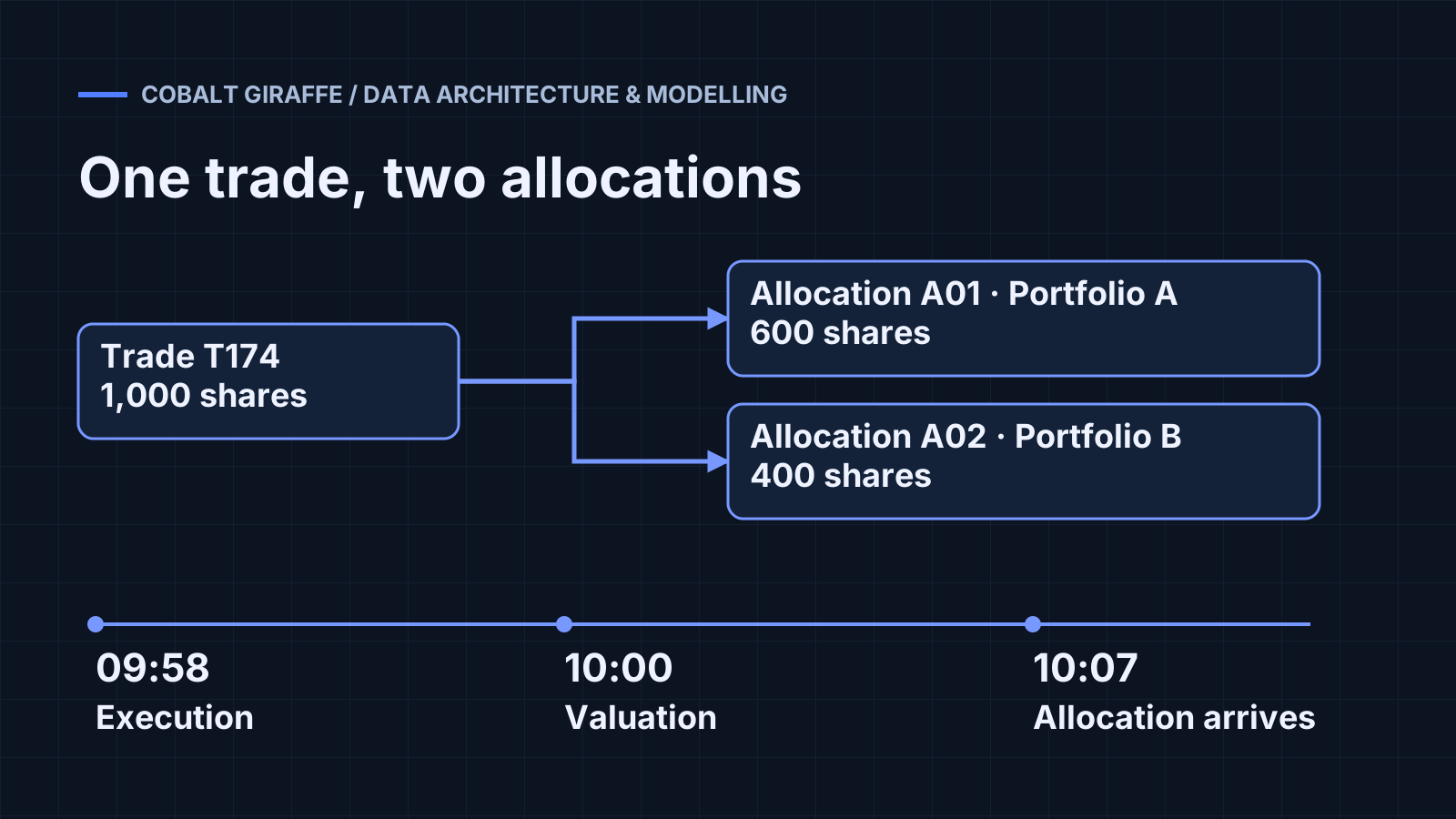
At 09:58, a fictional investment manager buys 1,000 shares in a single block trade. The execution reaches the valuation service before its 10:00 run. The allocation arrives at 10:07. It assigns 600 shares to Portfolio A and 400 to Portfolio B.
The service knows the firm bought 1,000 shares at 10:00. It cannot yet tell either portfolio manager how many of those shares belong in their portfolio. That distinction belongs in the model.
Give the allocation its own grain
A trade can be split across several portfolios, and a portfolio can receive allocations from several trades. Record the execution once at the trade grain. Record the allocation separately at one row per allocation line, carrying a trade reference, a portfolio key and the allocated quantity. The allocation is a fact in its own right because it records how much of the trade belongs to each portfolio.
| Fact | Record | Trade | Portfolio | Shares |
|---|---|---|---|---|
| Execution | T174 | T174 | — | 1,000 |
| Allocation | A01 | T174 | A | 600 |
| Allocation | A02 | T174 | B | 400 |
A join from the execution to its allocations repeats the 1,000-share quantity on both rows. Sum that column by portfolio and the trade appears to contribute 2,000 shares across the firm. Use allocated quantity for portfolio positions and execution quantity for trade totals. Reconcile the two at the trade grain. In this example, 600 plus 400 equals 1,000 once the allocation is complete.
A portfolio can have more than one line on the same trade, so retain the source allocation-line identifier. Treat repeated deliveries of the same line as one record, and handle corrections as revisions or explicit reversals so the same allocation cannot change positions twice.
Keep the valuation time and the time you learned the facts
Assume the investment manager’s policy makes these allocations effective at execution. At 10:07, the new facts therefore change what the service can say about positions at 10:00. They do not change what it knew when it first published.
| View | Valuation as of | Information available through | Contribution to A | Contribution to B |
|---|---|---|---|---|
| Original publication | 10:00 | 10:00 | Pending allocation | Pending allocation |
| Restated publication | 10:00 | 10:07 | 600 shares | 400 shares |
At a 10:00 mark of £25 per share, the allocation adds £15,000 and £10,000 respectively to the portfolios’ marked equity positions. Those are gross position-value movements. The full portfolio valuation also reflects the cash or settlement obligation and any relevant costs.
Store the business effective timestamp and when the service first had usable information. Keep the original publication and give the restatement its own version. Apply the price and FX selection rules for the 10:00 valuation point when rebuilding it. A quote observed after 10:00 belongs to a later valuation point.
That gives the portfolio manager and the operations team two answers they can trace. One explains the figure people saw at 10:00. The other shows what the 10:00 positions look like once the allocation is known.