
Enterprise Architecture · Cobalt Giraffe Insights
When should two parts of the business work differently?
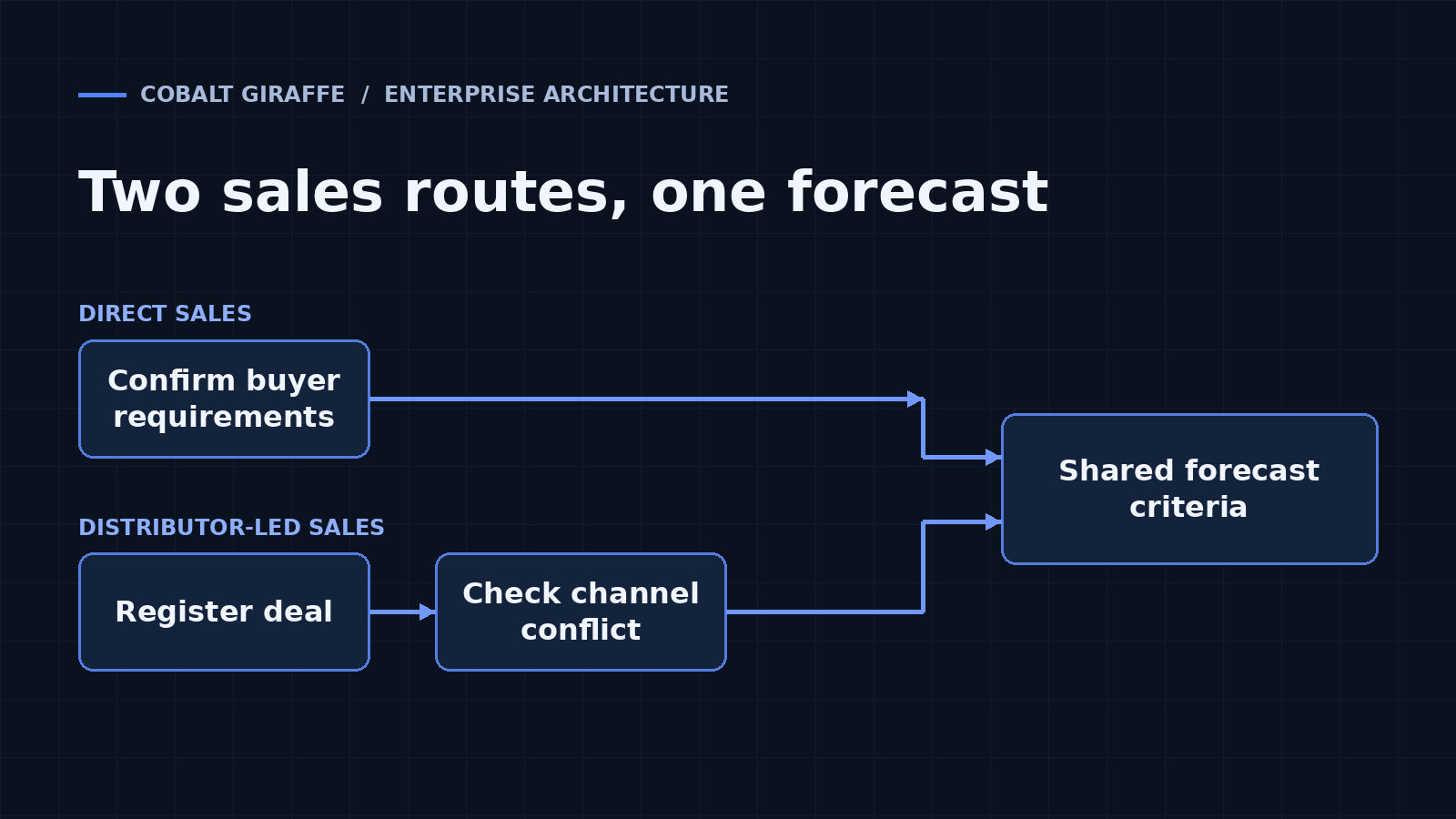
A fictional industrial supplier is rolling out a global CRM. Its Western European operation sells directly to large customers. Its Middle East operation sells comparable products through distributors. Head office wants a single view of the pipeline and proposes one sales process across both regions.
In the direct channel, a salesperson can qualify an opportunity after talking to the buyer and confirming the scope. In the distributor channel, the same conversation may be handled by a partner. Before committing commercial support, the supplier needs to accept the partner’s deal registration and check whether another distributor is already pursuing the account.
A global stage called “Qualified” could conceal those differences. If one region uses it after confirming the buyer’s requirements and the other uses it upon receiving a distributor registration, the pipeline report will combine opportunities at different levels of confidence.
Find the reason for the variation
Start with the decisions, the information needed and the people who can make them. In this example, the boundary follows the *sales channel*. If a Western European team starts selling through distributors, it will probably need the partner workflow too. Organising variation by geography would bake today’s organisation chart into tomorrow’s CRM.
Some variation has a clear business purpose. Partner registration helps manage channel conflict. Other differences may reflect the way a legacy system happened to be configured. Ask the local team what would happen if the step were removed. Look for a decision, obligation or handoff that would be lost. Apply the same test to a proposed global step that a local team would have to add.
Agree what the business needs to share
| Design decision | What to share | Where variation makes sense |
|---|---|---|
| Customer and partner identity | Common identifiers and explicit roles for the end customer, seller and partner. | Direct deals can have no distributor. Partner deals need an identified distributor and an owner for the commercial relationship. |
| Forecasting | Comparable evidence thresholds, a common reporting currency and an agreed basis for value. | Each channel can gather evidence differently. A submitted registration stays outside the committed forecast until it meets the agreed criteria. |
| Approvals | The intent of pricing and risk controls, with a record of who approved what. | Distributor conflict checks and commercial support approvals can sit in the partner workflow. |
Shared reporting takes more than a stage mapping. If the direct team records the end-customer price and the partner team records expected wholesale revenue, the global report needs a common basis or separate measures. Equally, two channels can share a forecast category once they agree what evidence qualifies a deal for it. Test both with actual examples before asking leadership to rely on the combined number.
Make the trade-off explicit
Every variation adds something to configure, support and train. A new workflow is worthwhile when it preserves a meaningful decision or control. Where the work and rules are genuinely shared, a common process makes future changes easier. Give someone ownership of each exception and agree how to review it as markets and channels change.
Take two deals into the CRM design workshop. Follow a direct sale and a distributor-led sale through their decisions, then ask leadership to interpret the resulting forecast. If both teams can do their work and leadership can explain what the numbers mean, you have a much better basis for deciding what to standardise.